 |
|
|
|


- I'm Online Chat Now
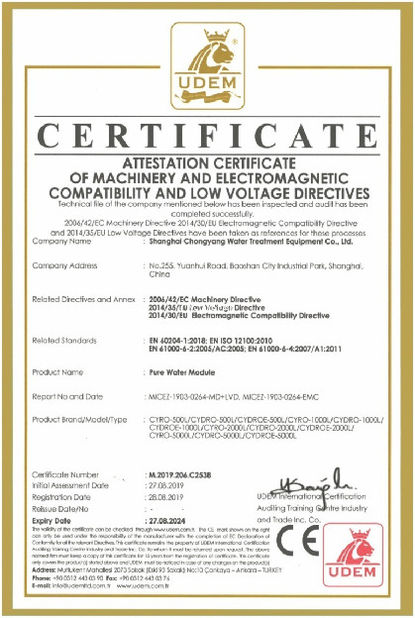
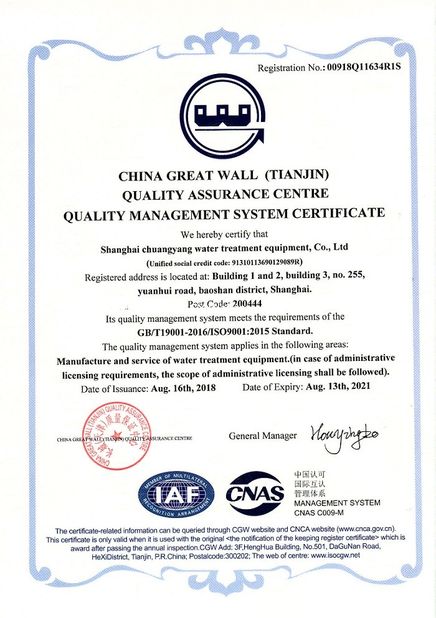
Certification
UF + SWRO Seawater Desalination Plant | Ultrafiltration Pretreatment System
Product Details:
Payment & Shipping Terms:
|
Detailed Product Description
| Feed Water Salinity: | Typically 30,000–45,000+ Ppm | Water Source: | Seawater |
|---|---|---|---|
| Technology: | UF + Seawater Reverse Osmosis | Product Water Capacity: | 10–2,000 M³/day Or Customized |
| Product Water TDS: | Typically <500 Ppm, Subject To Design | Pretreatment: | Ultrafiltration (UF) |
| UF Membrane: | PVDF / PES / Customized | UF Filtration: | Typically 0.01–0.1 μm |
| SWRO Membrane: | DuPont / Toray / Hydranautics Or Equivalent | Post-Treatment: | Remineralization + Disinfection |
| Cartridge Filter: | Typically 5 μm | SWRO Pressure: | Approx. 55–70 Bar |
| Salt Rejection: | Typically ≥99.5% | SWRO Recovery: | Approx. 35–50% |
| Energy Recovery: | Optional / Recommended For Larger Systems | Control System: | PLC + HMI Automatic Control |
| Installation: | Skid-Mounted / Modular / Containerized | Application: | Open Seawater Intake / High-Turbidity Seawater |
UF + SWRO Seawater Desalination Plant | Ultrafiltration Pretreatment System
Introduction
A UF + SWRO Seawater Desalination Plant combines ultrafiltration pretreatment with seawater reverse osmosis to provide a more stable desalination process for challenging seawater conditions.
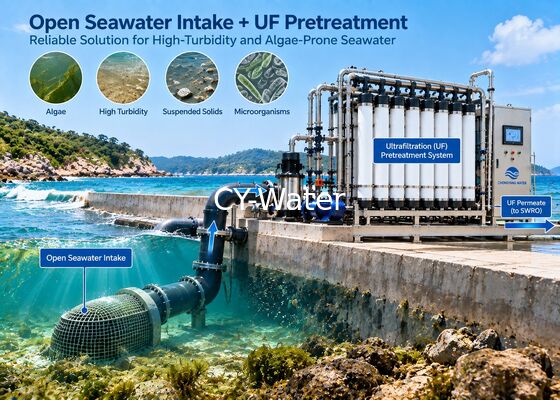
For open seawater intakes, raw water quality can change significantly due to tides, storms, algae, suspended solids, microorganisms, and seasonal variations. These contaminants can increase fouling risk and reduce the operating stability of downstream SWRO membranes.
By installing Ultrafiltration (UF) before the SWRO section, suspended particles, colloidal material, and microorganisms can be substantially reduced before the water enters the high-pressure desalination stage.
What Is a UF + SWRO Seawater Desalination System?
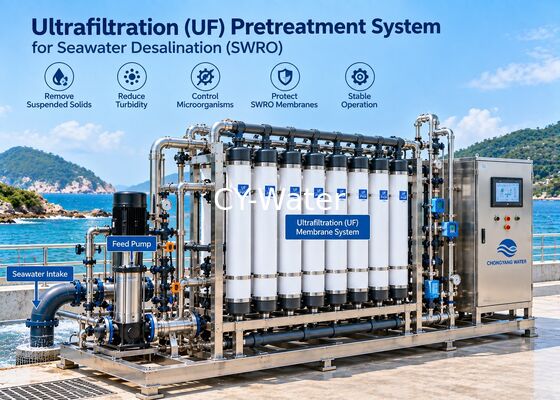
UF + SWRO is a two-stage membrane treatment concept. The UF system acts as the pretreatment barrier, while the downstream SWRO system removes dissolved salts.
UF membranes use fine membrane pores to separate suspended solids, colloids and microorganisms from seawater. However, UF does not remove the majority of dissolved salts. Salt removal is performed by the downstream high-pressure SWRO membranes.
This configuration is particularly suitable for seawater sources with variable turbidity or biological loading where conventional filtration alone may not provide sufficiently stable RO feed conditions.
UF + SWRO Treatment Process
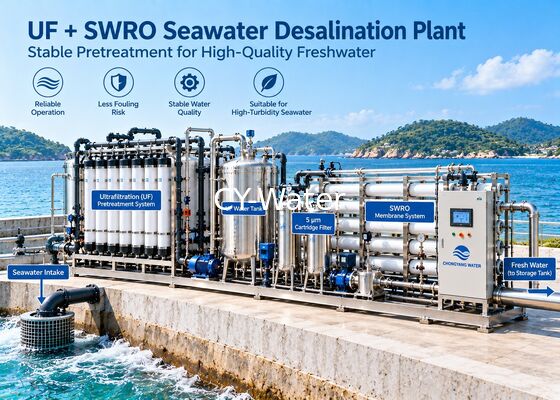
A typical ultrafiltration pretreatment seawater desalination process can be configured as:
Seawater Intake
Feed Pump
Coagulation
Ultrafiltration
UF Water Tank
Antiscalant
5 μm Cartridge
High-Pressure Pump
SWRO
Product Water
Mobile: Swipe horizontally to view the complete UF + SWRO process.
Why Use Ultrafiltration Before SWRO?
SWRO membranes require stable feed-water quality. Excessive suspended solids, colloids, algae, and biological matter can increase differential pressure, reduce permeate production, and increase membrane-cleaning frequency.
Reduce Suspended Solids Reduce Colloids Control Microorganisms Stabilize RO Feed Reduce Fouling Risk Improve System Reliability
The actual UF configuration, membrane flux, backwash frequency, chemically enhanced backwash strategy, and pretreatment chemicals should be determined from the raw seawater characteristics.
How the UF Pretreatment System Works
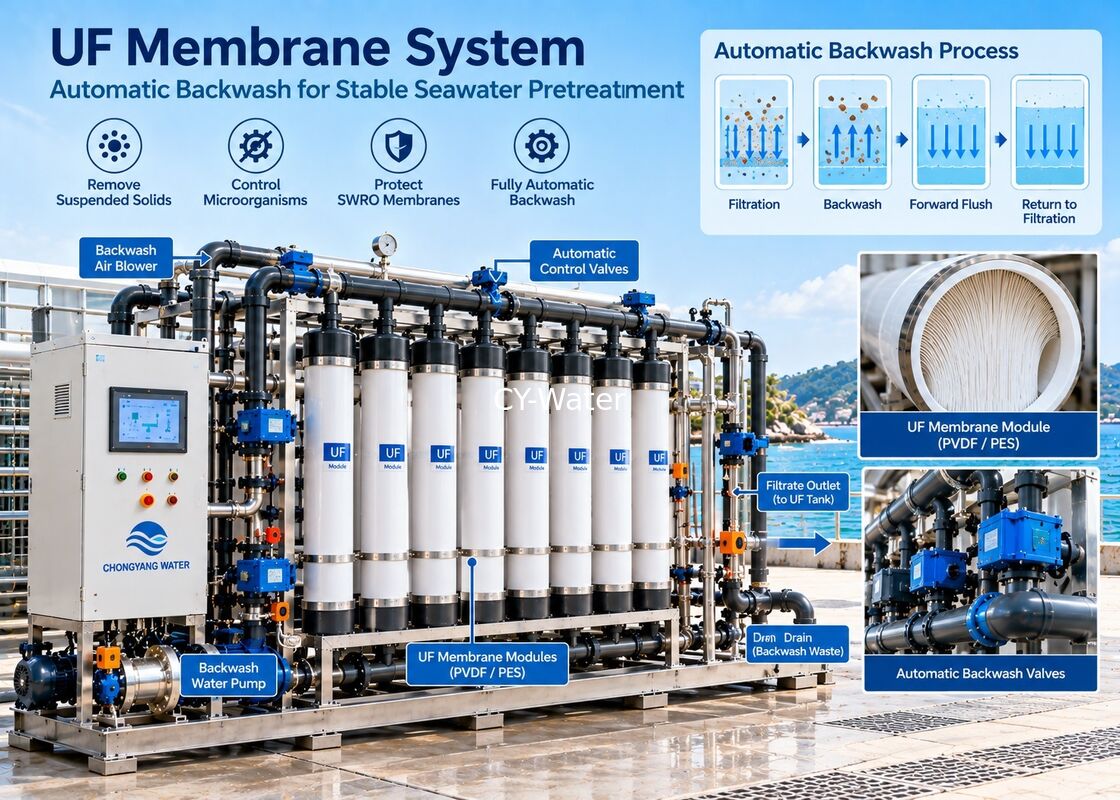
During normal filtration, seawater passes through the UF membrane and suspended contaminants are retained. The UF permeate is collected for downstream SWRO treatment.
As contaminants accumulate, the UF system performs automatic backwashing. Depending on feed-water conditions, chemically enhanced backwash or periodic chemical cleaning can also be incorporated.
Typical UF Operating Sequence:
Filtration → Backwash → Forward Flush → Filtration → Periodic Chemical Cleaning
Filtration → Backwash → Forward Flush → Filtration → Periodic Chemical Cleaning
UF + SWRO Plant Capacity
| Product Water Capacity | Typical Application | Configuration |
|---|---|---|
| 10–50 m³/day | Small Coastal Projects | Compact UF + SWRO |
| 50–200 m³/day | Hotels / Islands / Small Industry | Automatic UF + SWRO |
| 200–500 m³/day | Industrial / Municipal Projects | UF + SWRO + ERD |
| 500–1,000 m³/day | Large Coastal Facilities | Modular UF + Multi-Train SWRO |
| 1,000–2,000+ m³/day | Large Desalination Projects | Customized Multi-Train System |
Actual plant capacity and process configuration are determined according to seawater quality, required production, recovery, and operating hours.
Typical Technical Parameters
| Parameter | Typical Design |
|---|---|
| Feed Water | Seawater |
| Feed TDS | Typically 30,000–45,000+ mg/L |
| Pretreatment | Ultrafiltration (UF) |
| UF Membrane | PVDF / PES / Customized |
| UF Filtration Range | Typically 0.01–0.1 μm |
| SWRO Operating Pressure | Approx. 55–70 bar |
| SWRO Recovery | Approx. 35–50% |
| Salt Rejection | Typically ≥99.5% |
| Control | PLC + HMI Automatic Control |
| Installation | Skid / Modular / Containerized |
Typical Applications
Open Seawater Intake High-Turbidity Seawater Island Projects Coastal Industry Hotels & Resorts Municipal Desalination Power Plants Industrial Water Supply
Frequently Asked Questions
Why install UF before seawater RO?
UF helps reduce suspended solids, colloids and microorganisms before SWRO, providing more stable feed-water conditions and helping control membrane fouling.
Does ultrafiltration remove salt from seawater?
No. UF mainly removes suspended and colloidal contaminants. Dissolved salts are removed by the downstream high-pressure SWRO membranes.
Is UF required for every seawater desalination plant?
No. The pretreatment process should be selected according to seawater analysis, intake type, turbidity, biological loading, operating requirements, and lifecycle considerations.
Does the UF system require cleaning?
Yes. UF systems normally use automatic backwashing and may require chemically enhanced backwash and periodic chemical cleaning depending on membrane condition and feed-water quality.
Can UF + SWRO be installed inside a container?
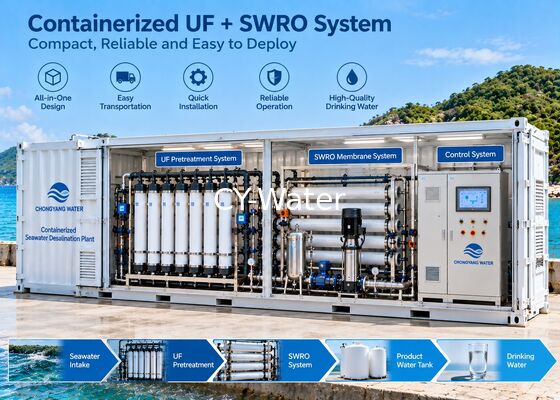
Yes. Depending on plant capacity, UF, SWRO, chemical dosing, CIP, electrical control, and other auxiliary equipment can be integrated into one or multiple containers.
Stable Pretreatment for Reliable SWRO Operation
For challenging seawater conditions, reliable SWRO operation begins with effective pretreatment. Combining ultrafiltration with seawater reverse osmosis provides a robust treatment concept for projects with variable turbidity, suspended solids, and biological loading.
CHONGYANG Water can customize the complete UF + SWRO system according to raw seawater analysis, required capacity, operating hours, site conditions, product-water requirements, and available utilities.
UF + SWRO ENGINEERING SOLUTION
Need a UF + SWRO Seawater Desalination Plant?
Send us your raw seawater analysis, required product-water capacity, intake method, daily operating hours, required water quality, power supply, and project location.
Our engineering team can configure the UF pretreatment, SWRO membrane system, chemical dosing, energy recovery, CIP, instrumentation, and automatic control system for your project.
Tag:
de salination plant,
swro
Contact Details
Shanghai ChongYang Water Treatment Equipment CO.,LTD.
Contact Person: Ms. Yanni.Wang
Tel: 86 15900488030
Fax: 86-21-66126659
Send your inquiry directly to us
More Seawater Desalination Systems
-
Seawater Desalination System for Island Drinking Water Supply
-
Seawater Desalination Plant for Hotels & Resorts | 5-1000m³/Day SWRO System
-
Boat Watermaker | Compact Boat Desalination System for Marine Fresh Water Supply
-
Commercial Seawater Desalination Plant for Hotel Resort Factory and Municipal Fresh Water Supply Projects
-
Turnkey Seawater Desalination System Manufacturer for Industrial Water Purification and Water Treatment Projects
-
High Efficiency Reverse Osmosis Seawater Treatment Plant for Industrial Desalination and Water Purification