 |
|
|
|


- I'm Online Chat Now
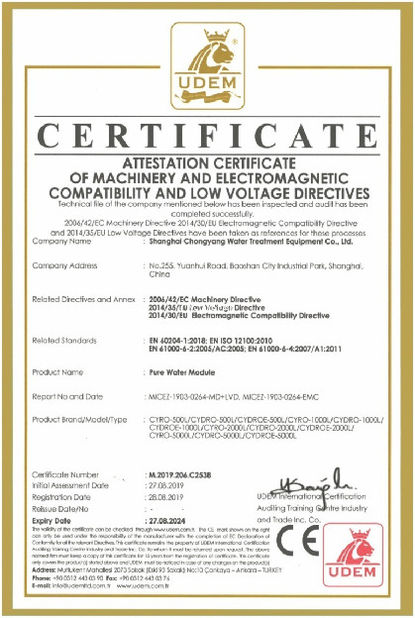
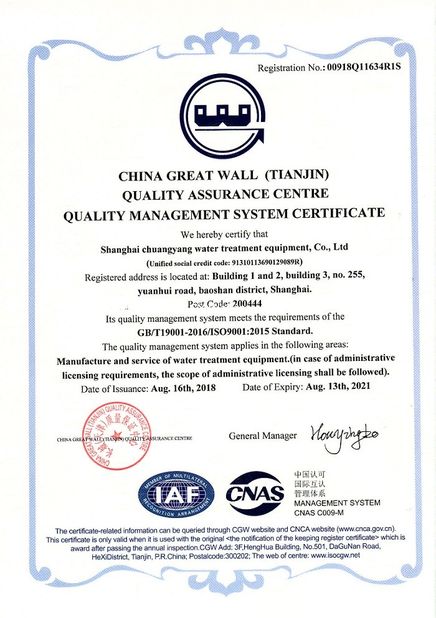
Certification
Energy Recovery SWRO Desalination Plant/Energy Recovery SWRO Plant | Low Energy Seawater Desalination System
Product Details:
Payment & Shipping Terms:
|

Detailed Product Description
| Feed Water Salinity: | Typically 30,000–45,000+ Ppm | Water Source: | Seawater |
|---|---|---|---|
| Technology: | SWRO + Energy Recovery Device | Product Water Capacity: | 50–5,000 M³/day Or Customized |
| Product Water TDS: | Typically <500 Ppm, Subject To Design | Pretreatment: | Ultrafiltration (UF) |
| UF Membrane: | PVDF / PES / Customized | UF Filtration: | Typically 0.01–0.1 μm |
| SWRO Membrane: | DuPont / Toray / Hydranautics Or Equivalent | Post-Treatment: | Remineralization + Disinfection |
| Cartridge Filter: | Typically 5 μm | SWRO Pressure: | Approx. 55–70 Bar |
| Salt Rejection: | Typically ≥99.5% | SWRO Recovery: | Approx. 35–50% |
| Energy Recovery: | Optional / Recommended For Larger Systems | Control System: | PLC + HMI Automatic Control |
| Installation: | Skid-Mounted / Modular / Containerized | Application: | Open Seawater Intake / High-Turbidity Seawater |
| Power Supply: | 380V / 400V / 415V / Customized |
Energy Recovery SWRO Plant | Low Energy Seawater Desalination System
Introduction
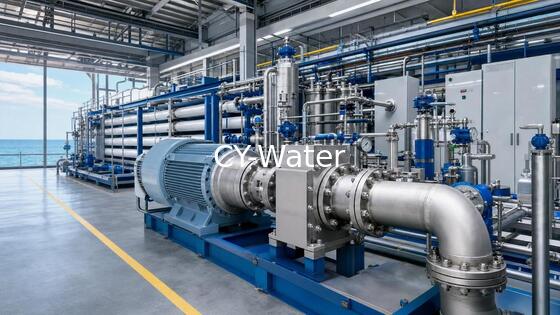
An Energy Recovery Seawater RO Plant combines high-pressure seawater reverse osmosis with an energy recovery device (ERD) to reduce electricity consumption during freshwater production.
Seawater reverse osmosis requires high operating pressure to overcome osmotic pressure and drive water through semipermeable membranes. The high-pressure concentrate stream still contains recoverable hydraulic energy that would otherwise be dissipated.
By recovering part of this energy, an SWRO plant with energy recovery can reduce net pumping energy demand and improve operating economics, particularly in continuous-duty desalination projects.
CHONGYANG Water provides customized skid-mounted, modular, and containerized SWRO systems with energy recovery for industrial, municipal, coastal, and island applications.
What Is an Energy Recovery SWRO Plant?
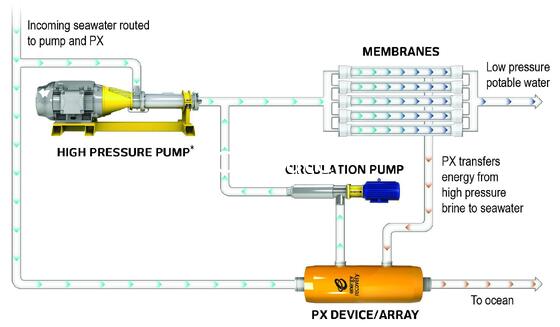
An energy recovery seawater desalination plant uses an ERD to transfer or convert hydraulic energy from the high-pressure RO concentrate stream.
The recovered energy assists the pressurization of incoming seawater, reducing the net power required by the high-pressure pumping system.
Common technologies include isobaric pressure exchangers and turbine-based energy recovery systems. Selection depends on plant capacity, hydraulic conditions, operating hours, equipment efficiency, and lifecycle cost.
SWRO Desalination Process with Energy Recovery
A typical process includes seawater pretreatment, high-pressure SWRO separation, energy recovery, and freshwater post-treatment.
Seawater Intake
→
Pretreatment
→
Chemical Dosing
→
Cartridge Filter
→
High-Pressure System
→
SWRO Membranes
→
Post-Treatment
→
Freshwater Tank
Energy Recovery Branch
High-Pressure SWRO Concentrate → Energy Recovery Device (ERD) → Low-Pressure Brine Discharge
Recovered hydraulic energy → Incoming Seawater Pressurization → Booster Pump / High-Pressure Feed Circuit
The diagram is conceptual. Actual ERD connections depend on the selected technology and hydraulic design. Swipe horizontally on mobile devices.
How Does an Energy Recovery Device Work?
In a conventional SWRO plant, concentrate leaves the membrane system at high pressure. Without energy recovery, much of this pressure energy is lost during discharge.
An isobaric pressure exchanger transfers pressure from the high-pressure concentrate to a portion of the incoming seawater. A booster pump then compensates for hydraulic losses and supplies the required pressure to the RO feed circuit.
High-Pressure Brine
→
Pressure Exchanger
→
Energy Transfer to Seawater
→
Reduced Net Pumping Energy
The ERD does not directly remove salt. Desalination is performed by the SWRO membranes, while the ERD improves the energy efficiency of the hydraulic system.
Key Components of an Energy Recovery SWRO Plant
1. Seawater Pretreatment
Multimedia filtration or ultrafiltration reduces suspended solids, turbidity, and particulate fouling risk. Chemical conditioning and cartridge filtration protect downstream membranes.
2. High-Pressure Pumping System
Provides the operating pressure required for SWRO separation. Pump selection considers seawater corrosion resistance, efficiency, flow, and system pressure losses.
3. SWRO Membrane Modules
High-rejection seawater membranes separate freshwater from dissolved salts. Membrane selection depends on feed salinity, temperature, required product-water quality, and recovery.
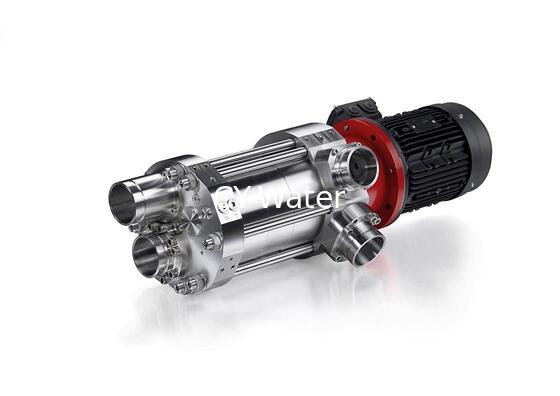
4. Energy Recovery Device
Recovers hydraulic energy from the concentrate stream. Pressure exchangers are commonly considered for energy-efficient continuous SWRO operation.
5. PLC and HMI Control
Coordinates pumps, valves, flushing, pressure monitoring, flow monitoring, conductivity measurement, alarms, and operating sequences.
6. CIP and Post-Treatment
A membrane cleaning system supports maintenance. Remineralization, pH correction, and disinfection can be added when potable water is required.
Energy Recovery SWRO Plant Capacity
CHONGYANG Water can configure different SWRO plant capacities according to water demand, operating hours, and site conditions.
| Capacity | Typical Application | Configuration |
|---|---|---|
| 50–100 m³/day | Small Coastal Facilities | Compact SWRO / ERD Feasibility Evaluation |
| 100–500 m³/day | Island and Industrial Projects | SWRO + Pressure Exchanger |
| 500–1,000 m³/day | Municipal / Industrial Supply | SWRO + ERD + Automatic Control |
| 1,000–3,000 m³/day | Large Coastal Facilities | Modular Multi-Train SWRO + ERD |
| 3,000–5,000+ m³/day | Large Desalination Projects | Customized Multi-Train Desalination Plant |
Illustrative capacity ranges, not standard model guarantees. ERD selection and project scope require detailed engineering confirmation.
Typical Technical Parameters
| Parameter | Typical Design |
|---|---|
| Feed Water | Seawater |
| Feed TDS | 30,000–45,000+ mg/L |
| Capacity | 50–5,000+ m³/day |
| Operating Pressure | Approx. 55–70 bar |
| Recovery Rate | Approx. 35–50% |
| Membrane Salt Rejection | Typically ≥99.5%, membrane-dependent |
| Energy Recovery | Isobaric ERD / Turbine-Based ERD |
| Specific Energy Consumption | Calculated per Project (kWh/m³) |
| Pretreatment | Multimedia / UF / Customized |
| Control | PLC + HMI / Optional SCADA |
| Installation | Skid-Mounted / Containerized / Modular |
Energy Efficiency and Operating Cost
Energy efficiency is a major consideration for SWRO projects operating continuously or in regions with high electricity costs.
The specific energy consumption (SEC) is expressed in kWh per cubic meter of produced freshwater. Actual SEC depends on feed-water salinity, membrane performance, recovery, pressure losses, pump efficiency, ERD efficiency, and auxiliary equipment.
Engineering Calculation
SEC (kWh/m³) = Total Electrical Energy Consumption (kWh) ÷ Freshwater Production (m³)
For a meaningful comparison, the energy-consumption boundary must be defined consistently, such as the SWRO high-pressure section or the complete desalination plant including pretreatment and post-treatment.
An ERD can substantially reduce the net energy required for seawater pressurization, but the final saving must be verified through a project-specific hydraulic and energy balance.
Typical Applications
Industrial Water Supply Municipal Desalination Island Freshwater Supply Coastal Manufacturing Power Generation Large Resorts Remote Coastal Facilities
Containerized SWRO Plant with Energy Recovery
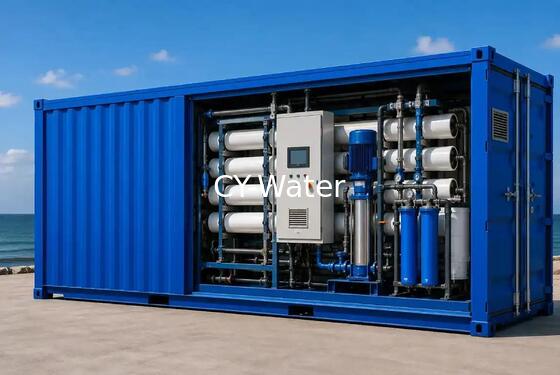
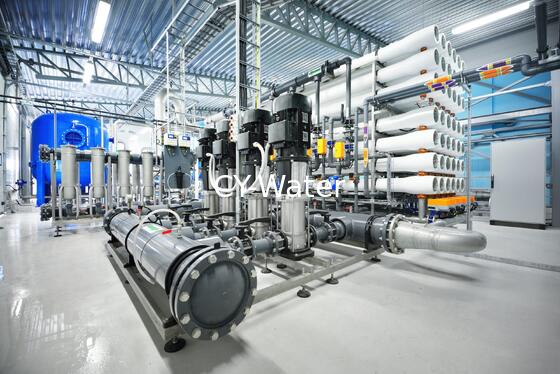
For remote coastal sites, an energy recovery SWRO system can be supplied in a containerized or modular arrangement.
Depending on capacity, the package may integrate pretreatment, chemical dosing, cartridge filtration, high-pressure pumps, SWRO membranes, ERD equipment, CIP, electrical panels, and automatic controls.
Factory assembly and testing can reduce site installation work. Larger systems may require multiple containers or separate equipment modules to provide sufficient maintenance clearance and safe operation.
Frequently Asked Questions
What is an energy recovery device in seawater RO?
An ERD recovers hydraulic energy from the high-pressure concentrate stream and uses it to reduce the energy required for seawater pressurization.
How much electricity can an ERD save?
Savings depend on the hydraulic design, ERD efficiency, membrane operating pressure, recovery, and plant capacity. A project-specific calculation is required.
Is energy recovery necessary for every SWRO plant?
No. ERDs are particularly attractive for medium and large plants with substantial operating hours. Smaller systems should be evaluated based on capital cost and expected energy savings.
Does an ERD improve product-water quality?
An ERD primarily improves hydraulic energy efficiency. Product-water quality is determined by membrane selection, feed conditions, operating parameters, and any downstream treatment.
Can energy recovery SWRO be containerized?
Yes. Containerized or modular configurations are possible depending on system capacity, equipment dimensions, maintenance access, and site conditions.
Conclusion: Energy-Efficient Seawater Desalination
An energy recovery SWRO plant combines effective seawater pretreatment, high-rejection RO membranes, optimized high-pressure pumping, and hydraulic energy recovery to support efficient freshwater production.
CHONGYANG Water provides customized seawater desalination solutions with optional energy recovery, automated control, and modular installation for industrial, municipal, and coastal projects.
ENERGY-EFFICIENT SWRO SOLUTION
Looking for an Energy Recovery Seawater RO Plant?
Send us your seawater analysis, required freshwater capacity, operating hours, product-water specification, power supply, electricity cost, and project location.
Our engineering team can evaluate SWRO membrane configuration, high-pressure pumping, energy recovery, pretreatment, and estimated operating energy requirements.
Tag:
de salination plant,
swro
Contact Details
Shanghai ChongYang Water Treatment Equipment CO.,LTD.
Contact Person: Ms. Yanni.Wang
Tel: 86 15900488030
Fax: 86-21-66126659
Send your inquiry directly to us
More Seawater Desalination Systems
-
UF + SWRO Seawater Desalination Plant | Ultrafiltration Pretreatment System
-
Seawater Desalination System for Island Drinking Water Supply
-
Seawater Desalination Plant for Hotels & Resorts | 5-1000m³/Day SWRO System
-
Boat Watermaker | Compact Boat Desalination System for Marine Fresh Water Supply
-
Commercial Seawater Desalination Plant for Hotel Resort Factory and Municipal Fresh Water Supply Projects
-
Turnkey Seawater Desalination System Manufacturer for Industrial Water Purification and Water Treatment Projects