 |
|
|
|


- I'm Online Chat Now
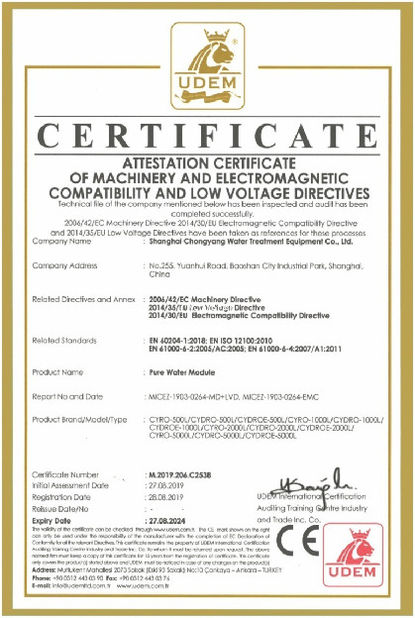
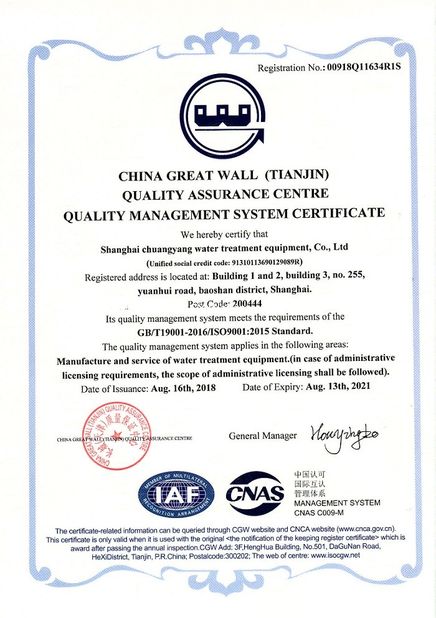
Certification
Containerized SWRO Plant | Modular Seawater Desalination System
Product Details:
Payment & Shipping Terms:
|

Detailed Product Description
| Feed Water Salinity: | Typically 30,000–45,000+ Ppm | Water Source: | Seawater |
|---|---|---|---|
| Technology: | SWRO + Energy Recovery Device | Product Water Capacity: | 50–5,000 M³/day Or Customized |
| Product Water TDS: | Typically <500 Ppm, Subject To Design | Pretreatment: | Ultrafiltration (UF) |
| UF Membrane: | PVDF / PES / Customized | UF Filtration: | Typically 0.01–0.1 μm |
| SWRO Membrane: | DuPont / Toray / Hydranautics Or Equivalent | Post-Treatment: | Remineralization + Disinfection |
| Cartridge Filter: | Typically 5 μm | SWRO Pressure: | Approx. 55–70 Bar |
| Salt Rejection: | Typically ≥99.5% | SWRO Recovery: | Approx. 35–50% |
| Energy Recovery: | Optional / Recommended For Larger Systems | Control System: | PLC + HMI Automatic Control |
| Installation: | Skid-Mounted / Modular / Containerized | Application: | Open Seawater Intake / High-Turbidity Seawater |
| Power Supply: | 380V / 400V / 415V / Customized |
Containerized SWRO Plant | Modular Seawater Desalination System
Introduction
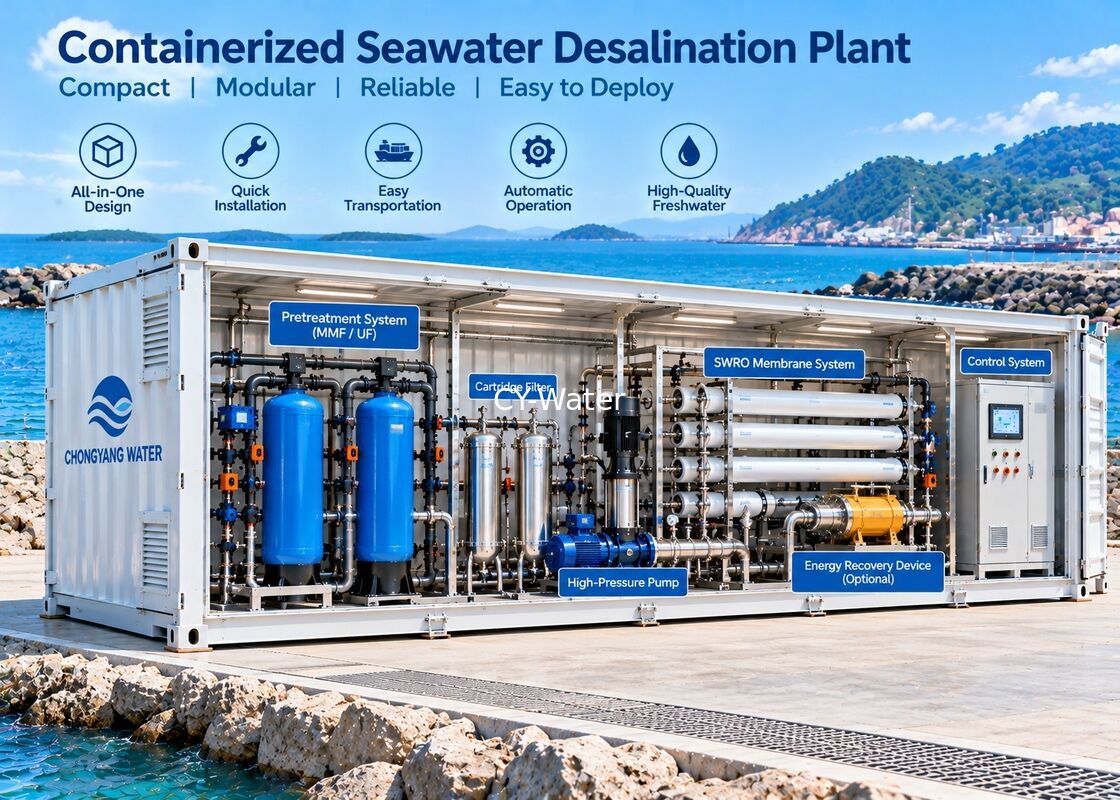
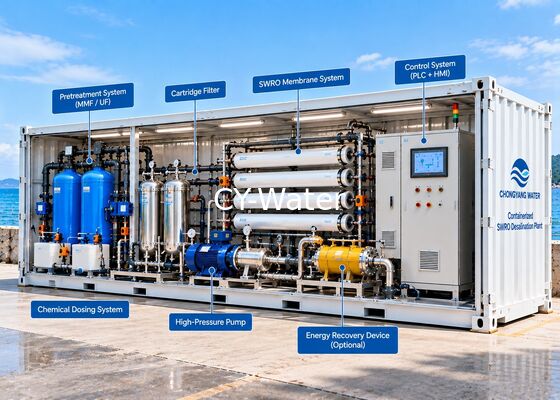
A Containerized Seawater RO Desalination Plant is a compact, modular water treatment solution designed to convert seawater into freshwater within a transportable containerized structure.
By integrating seawater pretreatment, reverse osmosis membranes, high-pressure pumps, chemical dosing, electrical controls, and optional post-treatment equipment, containerized SWRO systems reduce on-site assembly requirements and simplify transportation to remote locations.
These systems are widely considered for islands, coastal industries, construction camps, offshore support facilities, and emergency freshwater supply projects where conventional permanent plant construction may be difficult.
CHONGYANG Water provides customized 20FT, 40FT, 40HQ, and multi-container seawater desalination solutions according to project capacity, raw water quality, operating conditions, and installation requirements.
What Is a Containerized SWRO Plant?
A containerized SWRO plant is a seawater reverse osmosis system assembled inside one or multiple modified shipping containers or purpose-built equipment enclosures.
The system uses high-pressure reverse osmosis membranes to separate dissolved salts from seawater. Pretreatment protects the membranes from suspended solids and fouling, while post-treatment can be included to meet drinking water or industrial water requirements.
Compared with a conventional site-built desalination plant, the containerized configuration allows more equipment assembly, piping installation, wiring, and preliminary testing to be completed before shipment.
The seawater intake, brine discharge, product-water storage, civil foundations, and utility connections may remain outside the container depending on project scope.
Containerized SWRO Treatment Process
A typical containerized seawater desalination process includes the following treatment stages:
Seawater Intake
→
Feed Pump
→
Pretreatment
→
Chemical Dosing
→
Cartridge Filter
→
High-Pressure Pump
→
SWRO Membranes
→
Post-Treatment
→
Freshwater Tank
Mobile: Swipe horizontally to view the complete desalination process. Energy recovery and brine discharge are additional process branches where applicable.
Main Components of a Containerized SWRO System
1. Seawater Pretreatment
Multimedia filters or ultrafiltration membranes remove suspended solids and reduce particulate loading before SWRO. The selection depends on seawater intake conditions, turbidity, and biological activity.
2. Chemical Dosing and Cartridge Filtration
Antiscalant dosing and other required chemical conditioning protect the RO membranes. Cartridge filters provide a final particulate barrier before the high-pressure section.
3. High-Pressure Pump
The high-pressure pump supplies the operating pressure required to overcome seawater osmotic pressure. Materials must be selected for seawater corrosion resistance and the specified pressure conditions.
4. SWRO Membrane System
High-rejection seawater membranes separate dissolved salts from the feed stream. Membrane pressure vessels, manifolds, instruments, and isolation valves are integrated into the RO skid.
5. Energy Recovery Device
For suitable projects, an energy recovery device can recover hydraulic energy from high-pressure concentrate and reduce net pumping energy requirements.
6. PLC and HMI Control
Automatic control manages equipment start-up, shutdown, flushing, operating parameters, alarms, and protection interlocks. Remote monitoring can be included where communication infrastructure is available.
7. CIP and Post-Treatment
Membrane cleaning equipment can be integrated into the system. Remineralization, pH adjustment, and disinfection may be included for drinking water applications.
Containerized SWRO Plant Capacity
Plant capacity and container quantity are customized according to project requirements.
| Product Capacity | Container Concept | Typical Application |
|---|---|---|
| 10–50 m³/day | Compact Skid / 20FT Concept | Small Islands / Remote Facilities |
| 50–100 m³/day | 20FT / 40FT Concept | Small Resorts / Coastal Sites |
| 100–250 m³/day | 40FT / Modular Configuration | Island Communities / Industry |
| 250–500 m³/day | Multi-Container Configuration | Industrial / Municipal Projects |
| 500–1,000+ m³/day | Multiple Modular Trains | Large Coastal Water Supply |
Container sizes are preliminary layout concepts, not guaranteed equipment fit. Final configuration requires general arrangement drawings and maintenance clearance verification.
Typical Technical Specifications
| Parameter | Typical Design |
|---|---|
| Feed Water | Seawater |
| Feed Water TDS | 30,000–45,000+ mg/L |
| Product Capacity | 10–1,000+ m³/day |
| Operating Pressure | Approx. 55–70 bar |
| Recovery Rate | Approx. 35–50% |
| Membrane Salt Rejection | Typically ≥99.5%, membrane-dependent |
| Pretreatment | Multimedia / UF / Customized |
| Container | 20FT / 40FT / 40HQ / Multi-Container |
| Control | PLC + HMI / Optional SCADA |
| Post-Treatment | Remineralization / UV / Disinfection |
| Power Supply | 380V / 400V / 415V / Customized |
Container Engineering and Design Features
Factory-Assembled Equipment
Equipment skids, process piping, instrumentation, and electrical systems can be assembled and inspected before shipment.
Corrosion-Resistant Construction
Marine environments require appropriate corrosion protection for containers, structural supports, high-pressure piping, and seawater-wetted components.
Ventilation and Maintenance Access
Container layouts should provide ventilation, lighting, drainage, equipment access, and sufficient space for membrane replacement and routine maintenance.
Modular Expansion
Additional RO trains or containers can be considered when future water demand increases, subject to common utility and intake capacity.
Typical Applications
Remote Islands Coastal Communities Hotels and Resorts Industrial Sites Construction Camps Offshore Support Emergency Water Supply
Frequently Asked Questions
Can a complete SWRO plant fit inside one container?
Some small-capacity systems can fit inside one container. Larger systems may require multiple containers or external pretreatment and storage equipment.
What is the difference between a skid-mounted and containerized SWRO plant?
A skid-mounted plant is assembled on an equipment frame. A containerized plant places one or more skids inside a transportable enclosure with additional structural and utility considerations.
Can a containerized SWRO plant produce drinking water?
Yes, when the system includes appropriate post-treatment, disinfection, monitoring, and validation against the applicable drinking water requirements.
Does the system require an energy recovery device?
Energy recovery is optional. Its economic value depends on capacity, operating hours, electricity costs, and the selected hydraulic configuration.
What information is needed for system design?
A seawater analysis, required freshwater capacity, operating schedule, product-water specification, installation location, electrical supply, and intake/discharge conditions are recommended.
Conclusion: Modular Freshwater Production
A containerized seawater desalination plant provides a practical approach for deploying reverse osmosis equipment in remote or space-constrained locations. Factory integration, modular construction, and automatic control can simplify project execution and maintenance.
CHONGYANG Water develops customized containerized SWRO systems based on raw seawater quality, required production capacity, site conditions, and long-term operating requirements.
CONTAINERIZED SWRO SOLUTION
Need a Containerized Seawater Desalination Plant?
Send us your seawater analysis, required capacity, project location, daily operating hours, freshwater quality requirements, and available power supply.
Our engineering team can develop a customized SWRO process, container layout, equipment configuration, and technical quotation for your project.
Tag:
de salination plant,
swro
Contact Details
Shanghai ChongYang Water Treatment Equipment CO.,LTD.
Contact Person: Ms. Yanni.Wang
Tel: 86 15900488030
Fax: 86-21-66126659
Send your inquiry directly to us
More Seawater Desalination Systems
-
Energy Recovery SWRO Desalination Plant/Energy Recovery SWRO Plant | Low Energy Seawater Desalination System
-
UF + SWRO Seawater Desalination Plant | Ultrafiltration Pretreatment System
-
Seawater Desalination System for Island Drinking Water Supply
-
Seawater Desalination Plant for Hotels & Resorts | 5-1000m³/Day SWRO System
-
Boat Watermaker | Compact Boat Desalination System for Marine Fresh Water Supply
-
Commercial Seawater Desalination Plant for Hotel Resort Factory and Municipal Fresh Water Supply Projects